
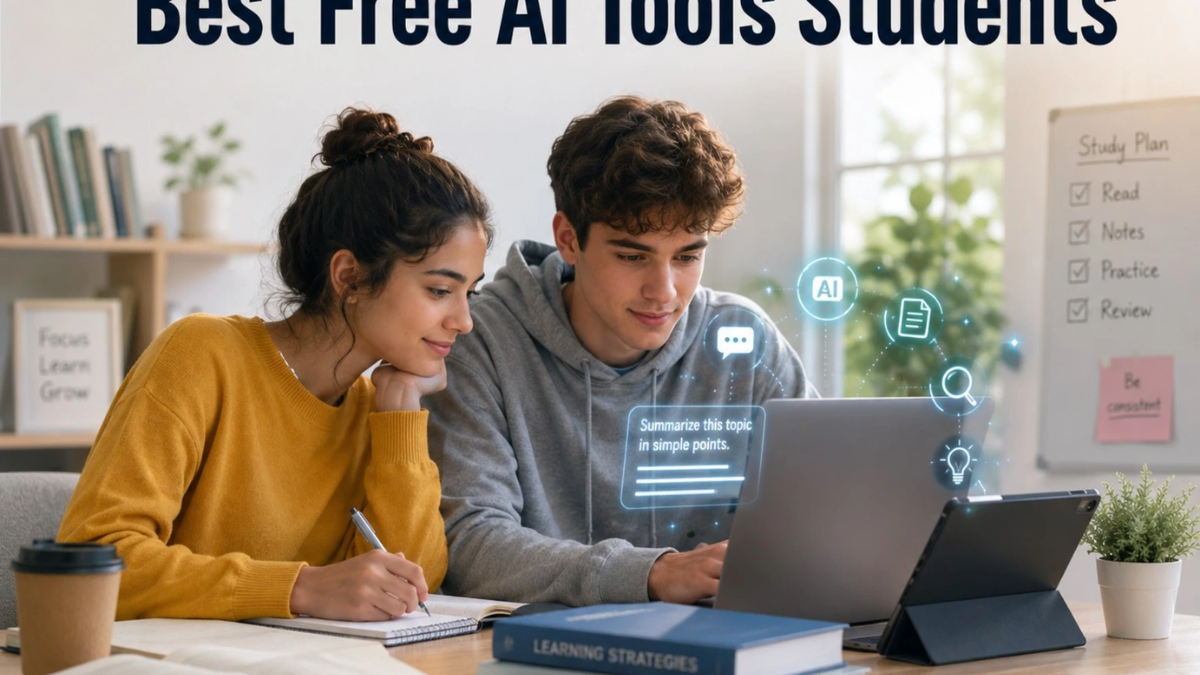
Studying has changed a lot over the Best Free AI Tools for Students to Study last few years, and a big part of that shift comes down to artificial intelligence quietly working in the background of a student’s daily routine. What used to take hours — combing through search results, retyping messy lecture notes, or rewriting an essay three times to fix grammar — can now be handled in minutes with the right app open on your laptop or phone. That doesn’t mean AI does the learning for you. It means the boring, repetitive parts of studying get out of the way faster, leaving more room for the part that actually matters: understanding the material.
The good news is that you don’t need a paid subscription to benefit from most of this. Finding the best free AI tools for students to study isn’t about chasing the flashiest app — it’s about matching the right tool to the task in front of you, whether that’s note organization, research help, writing correction, flashcards, or step-by-step math solutions. Whether you’re in high school, working through a college degree, or juggling a university thesis, there’s likely a free tool that fits into your workflow somewhere.
One thing worth keeping in mind before we go further: AI works best as a study partner, not a substitute for your own thinking. Students who lean on it to explain things, organize their time, and double-check their work — while still doing the reading, the practice problems, and the actual writing themselves — tend to get far more out of it than students who just copy whatever the AI spits out.
Why Students Are Turning to AI in the First Place
Between classes, assignments, part-time jobs, clubs, and everything else competing for a student’s time, the day fills up fast. AI tools take some of that pressure off by automating the parts of studying that don’t require deep thinking — formatting notes, drafting outlines, checking spelling — so students can spend their limited time and energy on the parts that do.
There’s also a personalization angle that’s easy to overlook. A textbook explains a concept one way. If that explanation doesn’t click, an AI tool can rephrase it five different ways until one of them finally makes sense. Some tools go further and turn your notes into quizzes or flashcards automatically, which is a level of customization no printed textbook can offer.
And because most of these tools live on your phone, tablet, and laptop at the same time, you’re not tied to one device or one location. A five-minute gap between classes is enough time to review flashcards or skim an AI-generated summary of last week’s reading.
What You Actually Gain From Using These Tools
You get your time back. Instead of manually organizing scattered notes or building a study calendar from scratch, AI handles the structure so you can focus on the content itself.
Your writing gets cleaner. Tools built for grammar and style catch mistakes you’d otherwise miss on your own, and over time you start noticing your own patterns and fixing them before the AI even flags them.
Research moves faster. Instead of opening twenty browser tabs, AI research assistants can summarize a topic and point you toward better sources in a fraction of the time.
Notes stop being a mess. Modern note apps turn scattered class notes into something searchable, so you’re not flipping through pages the night before an exam trying to find one specific definition.
Learning bends to fit you, not the other way around — you can ask the same question three different ways until the explanation actually lands.
The Tools Worth Knowing About
Here’s a rundown of the best free AI tools for students to study with — what each one does well, and where it fits into a typical study routine.
ChatGPT
Still one of the most flexible options out there. Students use it for everything from breaking down a confusing textbook chapter to brainstorming a thesis topic to getting a second opinion on an argument before submitting a paper. The trick is not to treat it as an answer machine — asking it to explain its reasoning, or to challenge your own argument, gets you a lot further than just copying whatever it produces.
Good for: homework help, planning essays, last-minute exam review, picking up new topics quickly.
Google Gemini
Gemini leans into research and writing support, and it plays nicely with Google Docs, Gmail, and Drive if that’s already where your work lives. It’s particularly handy for turning a pile of scattered information into something that actually makes sense — though, as with any AI tool, it’s worth double-checking anything important against an actual academic source before you cite it.
Good for: research projects, academic writing, everyday study support.
Grammarly
Grammarly has been a staple for a long time because it does one thing very well: catching grammar, punctuation, and clarity issues before a professor does. It also nudges you toward better sentence structure and a more consistent tone, which matters just as much in a scholarship essay as it does in a lab report.
Good for: essays, research papers, assignments, professional emails.
Notion AI
If you’re the type of student running five different apps just to keep track of assignments, Notion AI is worth a look. It combines note-taking, task tracking, and document writing into one workspace, and its AI layer can summarize lecture notes or turn a messy brain-dump into a clean outline.
Good for: semester planning, daily study routines, group project coordination.
Perplexity AI
Where Perplexity stands out is in sourcing — it tends to show where its answers actually come from, which is a big deal when you’re trying to figure out which sources are worth reading further. It’s a good starting point before diving into actual journals or textbooks, not a replacement for them.
Good for: literature reviews, early-stage research, presentation prep.
Microsoft Copilot
Copilot is built directly into Word, PowerPoint, and Excel, so if your school already runs on Microsoft software, it slots in without much friction. It helps with drafting, formatting, and putting together presentations that look like you spent more time on them than you actually did.
Good for: reports, slide decks, school projects built in Office apps.
Canva AI
Not every assignment is pure text — posters, infographics, and mind maps still show up constantly in classrooms. Canva AI makes it easy to put together something that looks genuinely designed, even if you’ve never touched a design tool before.
Good for: classroom presentations, visual study aids, posters.
Quizlet
Quizlet’s flashcard and quiz system is built around active recall, which tends to stick better in your memory than passive re-reading. It’s especially popular for vocabulary-heavy subjects and anything requiring pure memorization.
Good for: exam cramming, language learning, quick revision sessions.
Otter.ai
Otter records and transcribes lectures in real time, which means you can actually pay attention in class instead of racing to write everything down. Afterward, you get a searchable transcript you can skim instead of rereading an entire lecture.
Good for: university lectures, online classes, meeting notes.
Wolfram Alpha
For anything involving numbers, Wolfram Alpha is hard to beat. It doesn’t just spit out a final answer — it walks through the steps, which is exactly what you need when you’re trying to actually understand a problem rather than just get past it.
Good for: math, physics, chemistry, engineering coursework.
Quick Comparison
| Tool | Main Strength | Free Plan |
|---|---|---|
| ChatGPT | Learning & writing | Yes |
| Google Gemini | Research | Yes |
| Grammarly | Writing | Yes |
| Notion AI | Notes & planning | Limited |
| Perplexity AI | Research | Yes |
| Microsoft Copilot | Productivity | Limited |
| Canva AI | Design | Yes |
| Quizlet | Revision | Yes |
| Otter.ai | Lecture notes | Yes |
| Wolfram Alpha | Math & science | Yes |
Picking the Right One for You
There’s no single “best” tool here — it depends entirely on what’s eating up most of your time right now. If essays are your weak spot, start with a writing assistant. If you’re drowning in research, a tool built for summarizing and sourcing will save you more hours. If deadlines are the real problem, something like Notion that keeps everything in one place is probably more useful than another chatbot.
A few things worth checking before you commit to one:
- How steep is the learning curve?
- What does the free plan actually include, versus what’s locked behind a paywall?
- Does it work well on your phone, not just your laptop?
- How does it handle your data and privacy?
- Can you collaborate with classmates on it, if that matters for your work?
Trying two or three tools for a week each before settling on one is usually smarter than committing right away based on a recommendation alone.
Mistakes That Undercut the Whole Point
AI only helps if you use it the right way. A few habits quietly cancel out most of the benefit:
- Pasting AI output straight into an assignment without reading it critically first.
- Letting AI replace actual understanding instead of supporting it.
- Ignoring your school’s specific rules on AI use — these vary a lot and matter for academic integrity.
- Skipping the step of verifying facts against a real source.
- Feeding personal or sensitive information into tools that store your data.
Treat AI as a study partner that helps you organize, explain, and refine — not a shortcut around doing the actual work.
Getting More Out of the Tools You Choose
- Build a weekly schedule and stick to it more than you think you need to.
- Summarize chapters right after reading them, while the material is still fresh.
- Ask for simpler explanations whenever something doesn’t click the first time.
- Turn your own notes into practice quizzes instead of just rereading them.
- Reorganize your notes the same day as the lecture, not the week before finals.
- Cross-check anything important against a textbook or a trusted source.
- Take actual breaks — burnout undoes more progress than a missed study session ever will.
- Solve problems yourself before checking an AI’s version of the answer.
Where This Is Headed
AI in education isn’t slowing down. Expect more best free AI tools for students to study personalization, better multilingual support, and tighter integration with the platforms schools already use for online classes. Students who get comfortable using these tools responsibly now are likely to walk away with skills that carry over well beyond graduation — but the core things that actually make someone good at their field, critical thinking, creativity, and clear communication, still have to come from you.
At the end of the day, the best free AI tools for students to study aren’t about doing less work — they’re about doing the right work, faster, so you actually retain what you learn.
FAQ
Do I really need a paid AI tool, or is the free version enough?For most day-to-day studying — summarizing, organizing notes, basic research — free plans cover what you need. Paid tiers usually add speed, higher usage limits, or more advanced features, but they’re rarely a requirement for getting real value out of these tools.
What’s a smart way to use ChatGPT or Gemini for a class I’m struggling in?Ask for explanations in plain language first, then request a slightly more advanced version once the basics click. Following up with “why” questions instead of just accepting the first answer tends to build real understanding rather than surface-level familiarity.
Can these tools actually help with exam anxiety or last-minute cramming?Indirectly, yes. Tools like Quizlet turn scattered notes into quick-fire practice, which builds confidence faster than passive rereading. That said, they work best when used consistently in the weeks before an exam, not purely the night before.
Is it risky to paste my assignments or personal notes into these tools?It can be, depending on the platform. Avoid sharing anything with identifying personal details, and check whether the tool you’re using stores or trains on your input. When in doubt, stick to general questions rather than pasting full documents with sensitive information.
How do I know if my school allows AI tools for assignments?Policies differ a lot between institutions and even between individual professors. The safest approach is to check your syllabus or ask directly — using AI where it isn’t permitted can create real academic integrity issues, even if the intent behind it was harmless.
